
Transcription Dictionary
Fathom's Transcription Dictionary lets you add custom terms—company-specific words, acronyms, product names, or industry jargon—so your transcripts capture them accurately.
How to edit the Transcription Dictionary
Only Team or Account Admins can view, add, edit, or remove terms in your company's Transcription Dictionary. Navigate to Settings > Organizational Settings > Transcription Dictionary.
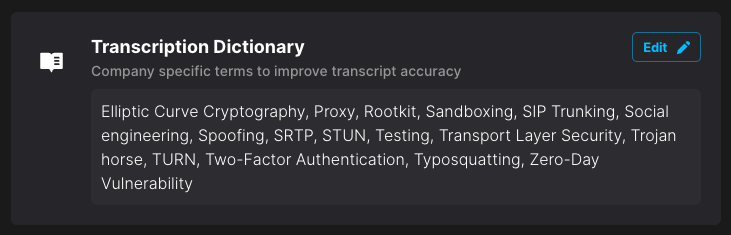
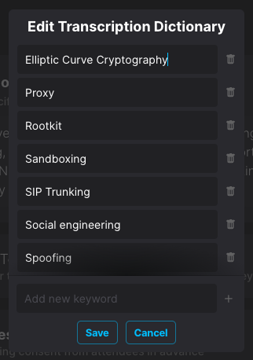
Click Edit to add, edit, or delete terms. You may need to scroll down the “Edit Transcription Dictionary” screen to see all the terms.
What are the Transcription Dictionary limits?
You can add up to 50 terms total.
Each term must be 100 characters or fewer.
Each term must be 6 words or fewer.
Terms must be added manually; bulk upload/import is not currently supported.
Best Practices for Setting Up the Transcription Dictionary
What to add
Proper nouns that Fathom repeatedly mishears
Company names
Product names
Customer names
Competitor names
Executive or team member names
Industry-specific organizations
Acronyms and initialisms
Especially if they are often confused with normal words.
Examples: internal product acronyms, team names, technical abbreviations.
Specialized jargon
Terms that are specific to your business or industry and unlikely to appear in general speech.
Examples: clinical terms, legal phrases, technical frameworks, proprietary methodology names.
Short multi-word phrases only when the phrase is a specific term
Good: “Acme Revenue Cloud”
Avoid: “the customer onboarding workflow for enterprise accounts”
Each term should be 6 words or fewer.
What NOT to add
Full sentences: When entries are full sentences, they stop behaving like vocabulary hints and can over-bias or confuse the transcription process.
Common words: Generic words like “account manager,” “sales call,” or “quarterly review” usually do not need to be in the dictionary.
Do not use the dictionary as a style guide. It is for transcription recognition, not for enforcing punctuation, formatting, tone, spelling preferences, or summary wording.
Do not try to exhaustively add regional spelling variants. The dictionary may help with specific variants, but it is not designed to cover every spelling difference or broad localization preference.
Do not paste large terminology lists without pruning. The best results come from a curated list of terms that are actually being misheard.
How to prioritize terms
Start with recurring terms across many meetings.
Prioritize high-impact mistakes. Add terms where mistranscription affects follow-up, coaching, CRM notes, search, compliance, or customer understanding.
Prefer unique terms over generic ones. A niche product name is a better candidate than a common business phrase.
Review actual transcripts first. Pull examples of terms Fathom gets wrong before adding a long list.
Keep entries short. Each term should be under 100 characters and no more than 6 words.
Operational guidance for admins
Treat it as org-wide: Since the dictionary affects transcript accuracy for the company, avoid adding highly personal or one-off terms unless they matter broadly.
Revisit it periodically: Review the dictionary every quarter or after major launches, rebrands, new product lines, or new customer segments.
Remove low-value terms: If a term is no longer used, rarely appears, or does not affect transcription quality, remove it to make room for better candidates.
Test after changes: After adding terms, review a few new transcripts where those terms are spoken naturally to confirm whether accuracy improves.