
Using Fathom with Google Meet
Fathom can capture your Google Meet calls in a few different ways. Every capture produces the same basic outputs: transcript, summary, action items. What media (i.e., audio, video) gets recorded depends on the capture mode you choose, which you can change from meeting to meeting.
Capture modes
Fathom 3.0+ has 4 default capture modes:
Bot Video sends a bot to the call to record the video, audio, and transcript.
Video (bot-free) records the video, audio, and transcript without sending a bot to the call.
Audio records the audio and transcript, without video.
Transcript records the transcript only, without audio or video.
Set a default capture mode in the desktop app, and choose a different mode for any upcoming meeting from the app tray. If the meeting or your setup doesn't support the mode you picked, the option shows "Not available for this meeting."
Choosing how each meeting is captured
Auto-capture sets which scheduled meetings Fathom captures automatically: All Meetings, External Meetings, Internal Meetings, or Off - capture manually (where every recording is started manually).
Default capture mode sets what Fathom records by default.
You can choose a capture mode per meeting in your list of upcoming meetings in the desktop app. This overrides your default mode for one meeting only.
If your organization has turned off bot-free capture, the bot-free options are greyed out and the bot records instead.
Capturing video with the Fathom bot
Available on all plans, on both macOS and Windows.
Fathom looks for meetings on your connected calendar with a Google Meet link and adds them to your desktop app drawer. The Fathom bot joins the call and records video, audio, and transcript. The bot appears in the participant list, so everyone in the call can see the meeting is being recorded.
How does the Fathom Notetaker join Google Meet?
When you capture a Google Meet call with Bot Video, the Fathom Notetaker joins signed into a Google account that Fathom owns, instead of as an anonymous guest. This helps the notetaker get into meetings that don’t allow anonymous guests. In a small number of cases, the bot's Google sign-in may fail. When this happens, it tries to join the meeting as an anonymous guest instead.
You don’t need to set anything up. Here’s what to expect:
The signed-in bot appears as “Fathom Notetaker.” The name comes from Fathom’s Google account and can’t be customized for Google Meet. The name is fixed only for signed-in bots. If the bot joins as an anonymous guest instead, it uses your customized bot name.
The signed-in bot requests to join the meeting. The host receives the request and can admit or deny it. If denied, the bot stops trying; if no one answers, it retries.
Meeting restrictions still apply. Signing in can help the bot join meetings that restrict anonymous guests, but it doesn’t guarantee access to every meeting. Google Meet may still identify it as a potential bot.
Once admitted, the notetaker appears in the participant list and captures the meeting’s video, audio, and transcript.
If the notetaker can’t join, ask the host to check the meeting’s access settings to admit it. For more help, contact Support.
Do I need to create or manage the notetaker’s Google account?
No. Fathom creates and manages the Google accounts the notetaker uses. They’re separate from your Google account and your organization’s Google Workspace. You don’t need to sign in, invite the account, or approve anything, and there’s nothing to manage on your end.
The account is only used to join the meeting. Your recording, transcript, and summary are still saved to your Fathom account, and your calendar connection to Fathom doesn’t change.
Capturing bot-free video (Fathom 3.0)
Available for Google Meet on macOS. Not available on Windows yet.
No bot joins the call. The Fathom desktop app records the meeting locally through the Fathom Chrome extension, and you get the same video, audio, and transcript as a bot recording.
What you need for bot-free Google Meet
In order to capture video bot-free, you will need the following:
Fathom desktop app on macOS 14.2 or later.
The Fathom Chrome extension installed (see section below on the Chrome extension)
Desktop app v3.12.0 or later if you join Meet in the installed Google Meet app or in a Chromium browser such as Arc, Brave, Dia, or Comet.
Google Chrome is the recommended browser.
If you choose bot-free video with Auto-capture on and the extension isn't connected when you join, Fathom records using your fallback (Send a bot or Capture audio).
Install the Fathom Chrome extension
In Fathom, open Settings and scroll to Fathom Apps.
Next to Chrome Extension, click Install and follow the prompts to grant the permissions that Fathom is requesting.
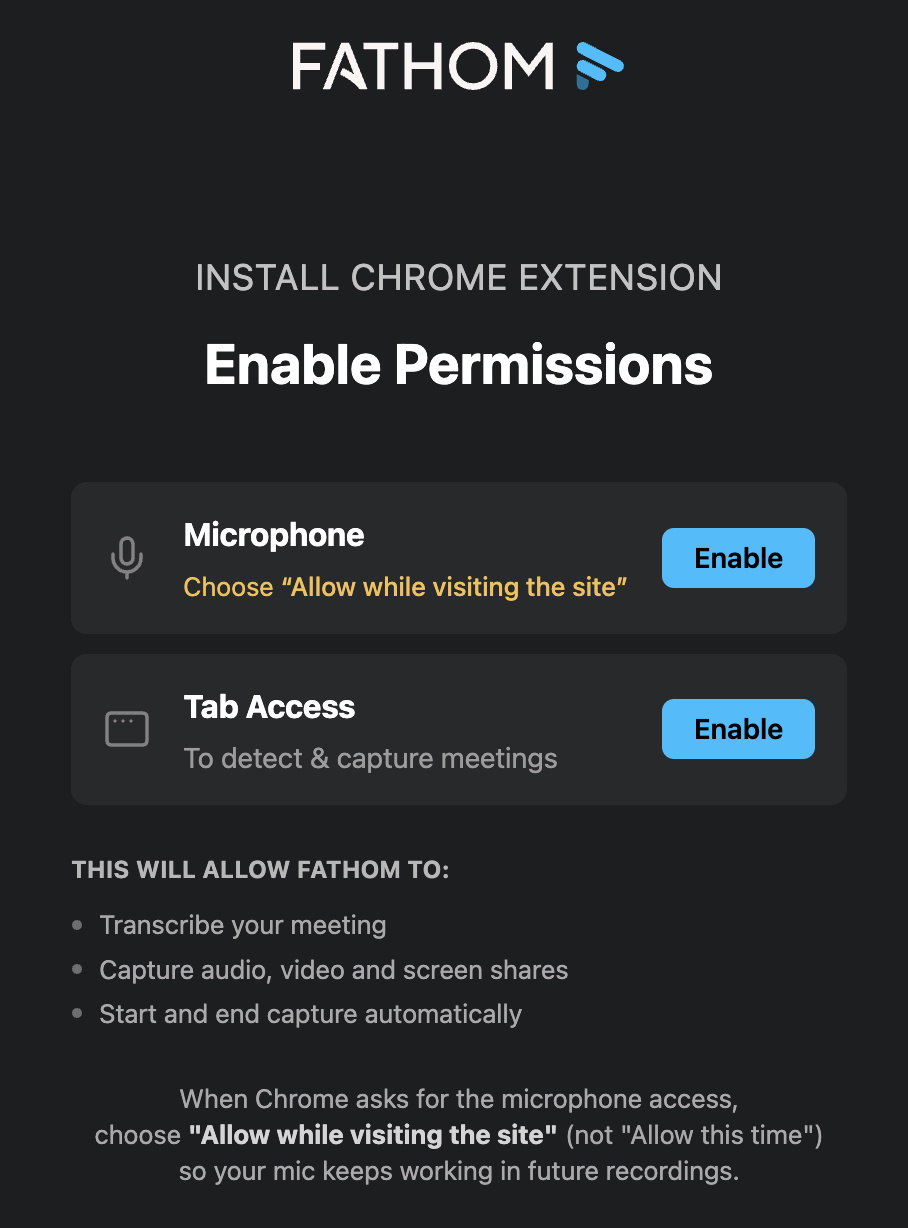
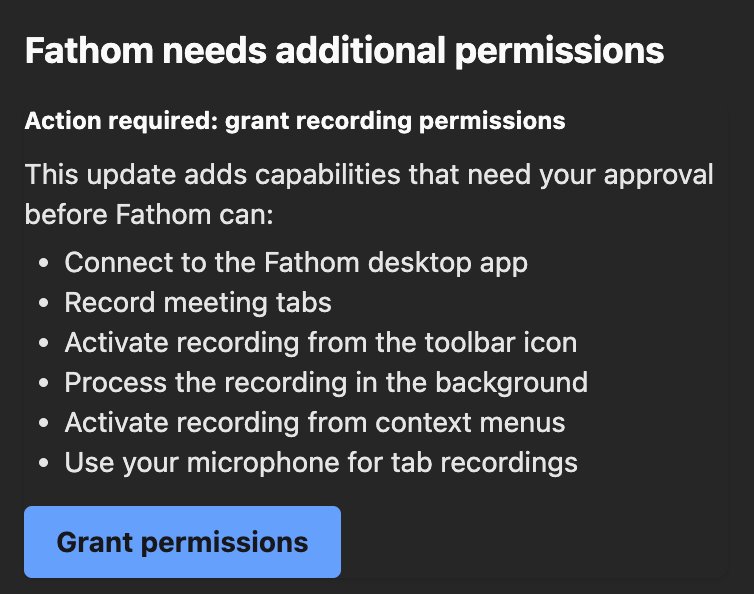
Make sure the extension is enabled, signed in with your Fathom email, and has the requested permissions. Chrome can turn the extension off after an update adds new permissions. Open chrome://extensions and approve the request to turn it back on.
The extension helps Fathom detect Google Meet calls, including unscheduled calls. It’s required for bot-free video capture on Mac. Fathom does not currently support recording on Linux or Chromebooks.
Important: Complete your Fathom desktop app and Chrome extension setup before joining your first Google Meet call to help ensure bot-free capture starts as expected.
What participants see
With bot video capture mode, the Fathom Notetaker appears in the participant list. With bot-free capture mode (i.e., bot-free video, audio, transcript), no bot appears in the call, and Fathom sends a consent message in the meeting chat instead when the Consent Chat Message setting is on.
Troubleshooting
To record Google Meet without a bot, you need Fathom 3.0 on macOS 14.2 or later, Google Chrome, and the Fathom Chrome extension installed and signed in with your Fathom email. Chrome must have the extension's current permissions approved.
Confirm the Chrome extension is installed and enabled
Chrome can disable an extension after an update adds permissions that require your approval. If this happens, you’ll need to approve the new permissions before the extension can run again.
Open
chrome://extensionsin Chrome and find Fathom.Make sure the extension is toggled ON. If Chrome says it needs new permissions, review the request and follow the prompts to approve the permissions and re-enable Fathom.
Check that Fathom can access Google Meet. With your Google Meet tab open, click Chrome’s Extensions (puzzle-piece) icon, open the menu (3 dots) next to Fathom, and look for “This can read and change site data.” Allow access on
meet.google.com.If Fathom isn’t listed, reinstall the extension from Settings → Fathom Apps → Chrome Extension.
After making changes, refresh your Google Meet tab and check for the Fathom recording button.
Verify the calendar event
Check that the meeting is scheduled in the Primary Calendar (Multiple calendars not supported)
The Meet link must be in the LOCATION field of the calendar invite (not just the description).
Still stuck?
Quit and reopen the Fathom desktop app, then rejoin the Meet call.
Ensure you’re on macOS or Window (Chromebooks, Linux aren’t supported).
We're here to assist — email help@fathom.video for additional guidance.